APCA AWA
Assessment of Working Ability
An entry-level evaluation of the basic temperament, obedience, neutrality, and environmental stability a working Presa Canario should demonstrate.
Purpose & Structure
Stable Character Under Everyday Pressure
The APCA Working Assessment evaluates foundational behavior through practical situations involving people, dogs, handling, movement, food, vehicles, gates, and unexpected distractions. The emphasis is on a dog that remains composed, responsive, and manageable with its handler.
Assessment Format
Ten core exercises. One consistent standard of confidence and control.
The optional protection exercise set is intended for dogs trained and prepared for protection work. It is separate from the core temperament and obedience assessment.
Obedience · Temperament · Neutrality · Environmental Stability
Core Assessment Exercises
Friendly Greeting
- 1.Handler and dog begin at one end of a 20-foot line, with the tester at the opposite end.
- 2.The dog heels for 10 paces as the tester approaches; handler and tester meet, shake hands, and converse for 10 seconds.
- 3.Both continue 10 paces in opposite directions after saying goodbye.
Required Standard
The dog remains in heel and neutral throughout the greeting.
Dog Neutrality
- 1.Two handler-and-dog teams begin 20 feet apart and walk toward one another on the judge’s signal.
- 2.At the end, both teams perform an about-turn and return to their starting points.
- 3.The crossing pattern is completed for four passes.
Required Standard
Dogs remain neutral, without aggression or attempts to engage.
Reaction to Distraction
- 1.Handler and dog start at a cone with the dog in heel.
- 2.As the team proceeds, a tester introduces a sudden environmental distraction near the course.
- 3.The team completes an about-turn and returns to the start.
Required Standard
The dog may notice the distraction but must recover without panic or bolting.
Sit and Down Upon Command
- 1.From heel, the handler commands a down and then pivots to face the dog.
- 2.The handler commands a sit, pivots away, then commands a down from the front position.
- 3.The exercise ends after the dog completes both positions.
Required Standard
The dog responds under control to each position command.
Staying in Place
- 1.The dog is placed in a sit or down at the start of a 20-foot line.
- 2.The handler walks to the opposite end and remains there for up to two minutes.
- 3.The dog holds position until the handler returns.
Required Standard
The dog remains in the assigned position for the full exercise.
Recall
- 1.The dog is placed in a sit or down at the start of a 20-foot line.
- 2.The handler walks to the opposite end, waits 10 seconds, and calls the dog once on the judge’s signal.
Required Standard
The dog responds promptly and returns directly to the handler.
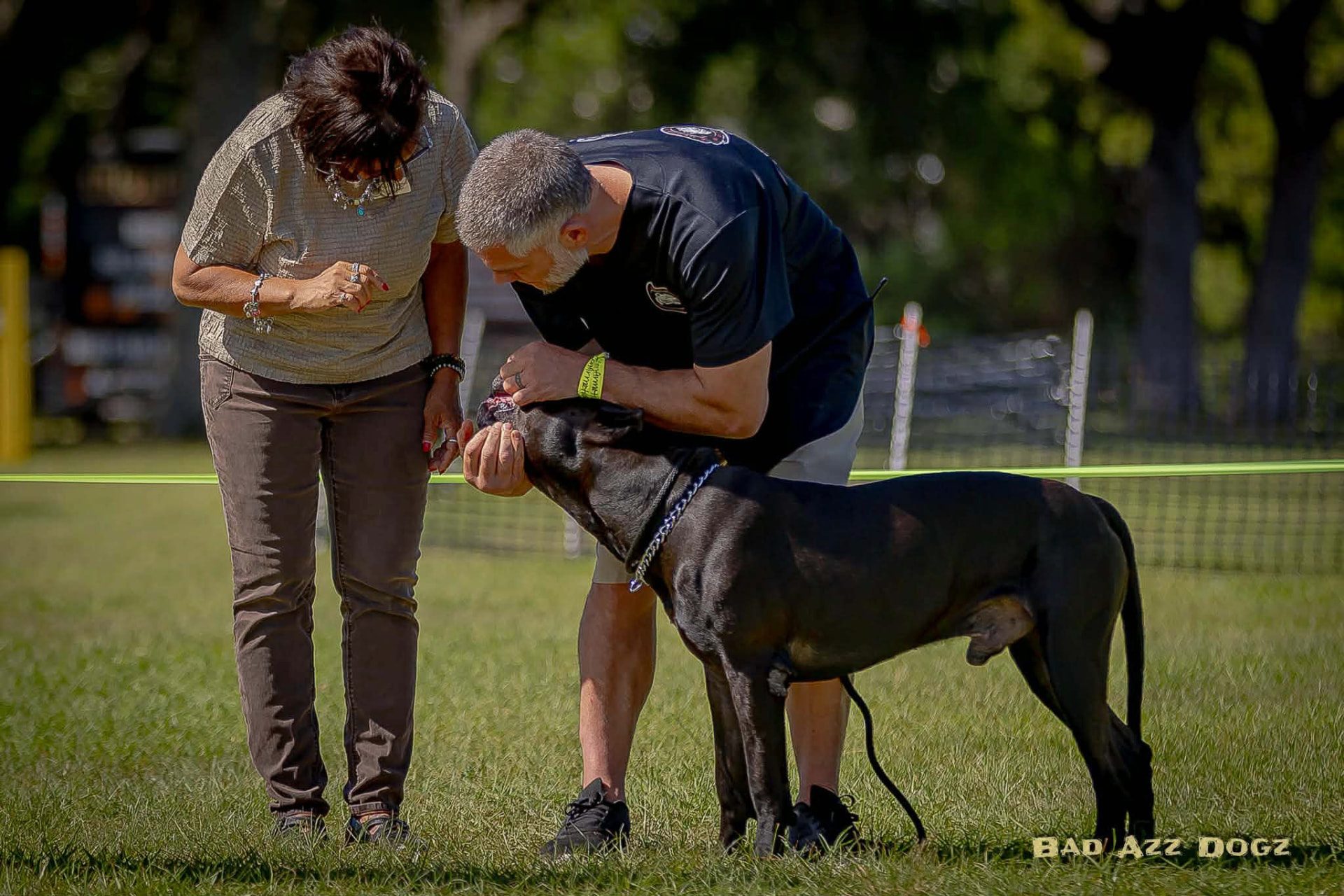
Veterinary Check
- 1.The dog stands on a small platform while the evaluator handles the dog’s body and checks the ears, teeth, or neck area.
- 2.A microchip-reader-style scan may be performed over the head and neck.
Required Standard
The dog shows no shyness, avoidance, fear, or resentment during routine handling.
Heeling Through a Gate
- 1.The team heels to a cone outside a gate and the dog sits while the handler opens it.
- 2.The handler proceeds through, closes or latches the gate, and continues with the dog under control.
Required Standard
The dog waits for permission and remains controlled around the gate.
Loading Into and Out of a Vehicle
- 1.The dog heels to the rear of a vehicle and sits while it is opened.
- 2.On instruction, the dog enters and performs a down; after recall, the dog exits and returns to heel.
Required Standard
The dog loads and unloads confidently, without shyness or hesitation.
Waiting for Food
- 1.The dog heels to a cone and holds a stay while the handler fills and places a food bowl.
- 2.After 10 seconds, the handler returns and completes the exercise with the dog in heel.
Required Standard
The dog does not break the stay or move toward the food.
Optional Exercise Set
Protection Assessment Exercises
These exercises assess control, confidence, engagement, grip, release, and recall in a structured protection-work setting. They are not part of the core entry-level assessment.
Friendly Greeting With a Decoy
- 1.The team begins at a cone facing a blind as the decoy approaches at a brisk pace.
- 2.The dog remains in heel while the decoy gives an energetic greeting and handshake gesture.
- 3.The decoy returns to the blind after 10 seconds.
Required Standard
The dog remains neutral and alert, without attack behavior.
Threat and Handler Protection
- 1.The team heels to the blind, returns toward the start, and the decoy emerges with an attack stick.
- 2.The dog shows confidence and guarding behavior while the handler maintains control.
- 3.When the judge signals, the decoy provides three stick hits and drives the dog before the exercise ends.
Required Standard
The dog demonstrates confidence, engagement, and control without fear or weakness.
Attack and Grip
- 1.The decoy emerges from the blind with an attack stick while the handler sends the dog from the start cone.
- 2.The dog engages and establishes a grip as the decoy applies pressure during the drive.
- 3.On the judge’s signal, the decoy stops and the handler commands the out and recalls the dog to heel.
Required Standard
The dog performs the grip, release, and recall under the handler’s control.
Required Equipment
Prepared for the Assessment
Leash
A four-foot or six-foot leash
Agitation Collar
An approved agitation collar
Fur-Saver Collar
Attached to the dead ring
Scoring
Pass / Fail Standard
- A minimum of 75% of the total available points is required.
- No exercise may receive a complete failure.
- The dog must demonstrate control, confidence, stability, and working ability.
Questions about the assessment
Connect With the APCA
Contact the association for current assessment information, participation requirements, and scheduling details.